

As a Chief Financial Officer (CFO), you’ve undoubtedly worked tirelessly to achieve your success. But have you ever wondered what it would feel like to have complete control over your own schedule and work-life balance?
By becoming a fractional CFO, you can use your expertise to help multiple companies grow while also having the time and energy to enjoy your own life.
In fact, many CFOs have left full-time positions to regain control of their careers and their time.
But how did they do it? That’s what you’ll find out in this blog post as we uncover how to become a fractional CFO.
What is a fractional CFO?
A fractional CFO, also known as a part-time CFO or interim CFO, is a Chief Financial Officer who works for various companies on a part-time or by-project basis.
This flexible way of working allows startups and small businesses to access the same level of financial expertise and strategic guidance as a full-time CFO without the overhead costs associated with hiring a full-time employee.
Fractional CFOs help businesses with everything from financial reporting to budgeting can and strategic planning. For the most part, they work on a contract or consulting basis with a services and/or retainer agreement in place.
What does a fractional CFO do?
Fractional CFO services involve a variety of responsibilities, such as:
- Funding and negotiations
- Budget and resource allocation
- Optimizing financial operations, strategies, and internal processes
- Supporting senior management with data-driven decisions
- Overseeing regulatory procedures and changes
- Managing cash flow
- Raising capital
- Forecasting finances
- Support during an acquisition or merger
- Routine bookkeeping and accounting
 Peter Turner
How an outsourced CFO works alongside your team
One of the most common questions from business owners is, “How will an outsourced CFO actually fit in with my current accounting team or bookkeeper?”
It’s a fair concern. Nobody wants confusion, duplicated work, or turf wars. Here’s how integration usually plays out in the real world.
Think of your bookkeeper or accounting team as the foundation: they handle daily transactions, payroll, invoicing, and make sure the numbers are accurate and up-to-date.
The outsourced CFO builds on that foundation, using the data your team provides to drive higher-level analysis, strategic planning, and decision-making.
In practice, this means the CFO sets the agenda for financial reporting, cash flow forecasting, and budgeting, while the accounting staff handle the nuts and bolts.
For example, your bookkeeper might close the books each month, and the CFO reviews those numbers to identify trends, flag risks, or prepare materials for investors and the board.
Communication is key: regular check-ins, clear reporting lines, and defined responsibilities keep everyone rowing in the same direction.
Worried about overlap? A good outsourced CFO will clarify roles from day one.
They’ll often introduce new processes or tools, but always in partnership with your team, not as a replacement.
In fact, many bookkeepers and controllers find their work becomes more impactful with a CFO’s strategic guidance.
The result is a more cohesive, empowered finance function that supports your business goals without stepping on anyone’s toes.
 Sabrinthia Donnelly
Is a fractional CFO the same as a full-time CFO?
Although the two share similarities, a fractional CFO and a full-time CFO are not quite the same. They have similar skills and responsibilities, but with a few key differences:
1. Time commitment
A CFO typically works on a full-time basis, while a fractional CFO can be hired for a more flexible arrangement. This could involve working part-time or only for the duration of a specific project.
2. Scope of responsibility
CFOs are tasked with overseeing all the financial activities of a company, which includes everything from financial planning and forecasting to compliance and risk management.
However, a fractional CFO may have a more focused role, providing support for specific financial areas, such as reporting, analysis, or strategic planning.
3. Company size
CFOs typically work for larger companies that have more complex financial operations, while fractional CFOs often work with smaller or mid-sized companies.
This is because smaller companies and startups may not have the resources to hire a full-time CFO, but still need the expertise of a financial executive to help manage their operations and growth.
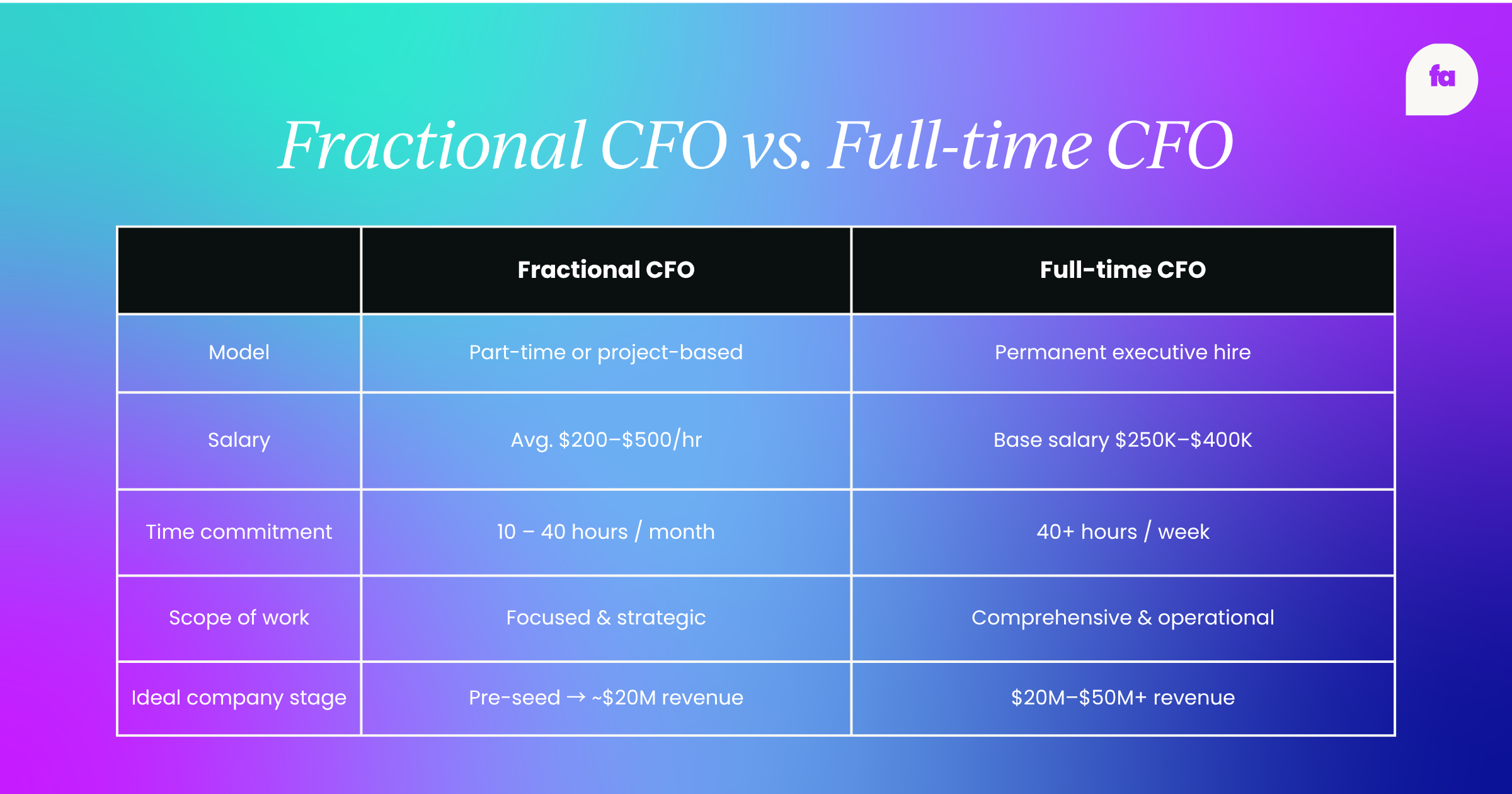
Company cost (fractional): The average fractional engagement in 2026 runs $3,000–$12,000/month. Typical saving of 50–80% vs full-time with no benefits, payroll taxes, or equity dilution.
Company cost (full-time): A full-time CFO commands $250K–$400K in base salary, rising to $350K–$600K fully-burdened with bonus, benefits, payroll taxes, and equity.
Ideal company stage (full-time): The revenue threshold for justifying a full-time hire has edged upward. Full-time CFOs are best suited for companies exceeding $20M in annual revenue, or those managing complex structures such as multiple divisions, subsidiaries, or heavy regulatory oversight.
This explains why fractional CFO rates have risen even as the model remains far cheaper than a full-time hire.
Fractional CFO vs. outsourced controller
It’s easy to see why business owners and founders sometimes mix up the roles of a fractional CFO and an outsourced controller.
Both are external finance experts, but their focus, impact, and the value they bring to your business are quite distinct. Let’s break it down.
A fractional CFO is your strategic partner. They’re thinking big picture: long-term financial planning, fundraising, scenario modeling, and helping you chart the course for sustainable growth.
They’ll work with you on capital structure, investor relations, and even M&A strategy.
If you’re asking questions like, “How do we scale profitably?” or “What’s our cash runway if we launch a new product?”, that’s where a fractional CFO shines.
An outsourced controller, on the other hand, is all about the numbers behind the scenes.
Think of them as the guardians of your financial data: managing the monthly close, ensuring compliance, maintaining internal controls, and delivering accurate, timely financial statements.
They’re essential for keeping your books clean and audit-ready, but they’re typically not driving strategic change or advising on high-level financial decisions.
Here’s a quick side-by-side:
- Fractional CFO: Strategic planning, forecasting, capital raising, board reporting, scenario analysis, M&A support.
- Outsourced controller: Month-end close, GAAP compliance, process documentation, audit prep, financial reporting, internal controls.
So, when should you hire each?
If you’re facing rapid growth, fundraising, or need high-level financial leadership, a fractional CFO is the way to go.
If your main concern is accurate reporting, compliance, and process improvement, an outsourced controller is your best bet.
Sometimes, companies need both. Controllers to keep the financial engine running and CFOs to steer the ship. The key is understanding what your business needs right now, and building your finance team accordingly.
When does a company need a fractional CFO?
If you're considering becoming a fractional CFO, it's important to know when a company might need your services.

A company’s financial needs change as it scales. In the early stages of growth, a company might start building a finance team by first hiring a bookkeeper for basic accounting duties.
Next on the priority list is usually a controller, who’ll perform financial planning activities.
When companies have scaled enough that the complexity of finance requires more expertise, they’ll often consider hiring a fractional CFO.
There are a few tell-tale signs when a company is ready for a fractional CFO, including:
- Growth: Companies experiencing rapid growth may need a fractional CFO to help manage their finances and strategize for the future. As the company grows, financial planning and analysis become more complex and time-consuming, and a fractional CFO can help keep everything on track.
- Special projects: Some companies want help with a specific project or initiative. For example, if a company is looking to raise capital or acquire another business, a fractional CFO can provide expertise and guidance throughout the process.
- Cost savings: A fractional CFO can provide the same level of expertise and guidance as a full-time CFO but at a lower cost.
- Interim needs: If a company's full-time CFO leaves or is on leave, a fractional CFO can fill the gap until a permanent replacement is found.
- Scalability: A fractional CFO can easily adjust their level of involvement based on the company's needs and resources.
Interim or long-term outsourced CFO?
You might be wondering: should you bring in an interim CFO, or is a long-term outsourced CFO service a better fit?
The answer depends on your company’s current stage and the challenges you’re facing.
An interim CFO typically steps in during a period of transition or crisis. Maybe your CFO just left unexpectedly, you’re in the middle of a merger, or you need someone to steady the ship while you search for a permanent hire.
Interim CFOs are experts at jumping into the unknown, quickly assessing the situation, and providing stability.
Their focus is short-term: they fill the leadership gap, maintain continuity, and often help with urgent priorities like audits, restructurings, or investor communications. Once the dust settles or a permanent CFO is found, their role wraps up.
A long-term outsourced CFO, on the other hand, is all about building a relationship and driving sustained value.
These professionals become embedded in your leadership team, guiding strategic planning, forecasting, and growth initiatives over months or even years.
They’re ideal for companies that need ongoing financial expertise but don’t require (or can’t yet afford) a full-time CFO.
If you’re scaling, entering new markets, or want to professionalize your finance function for the long haul, this model delivers continuity and deep institutional knowledge.
So, how do you decide? If you’re facing a sudden leadership gap or a one-off event, an interim CFO is your go-to.
If you want to invest in strategic finance leadership for the long-term, an outsourced CFO is the better choice.
Take a moment to assess your business timeline, goals, and pain points, then choose the model that aligns with where you are and where you want to go.
Red flags when hiring a fractional CFO
The fractional CFO market has grown fast, and so has the number of bookkeepers, controllers, and accounting generalists rebranding themselves as fractional CFOs.
The label "fractional CFO" is broad. Some are true strategic finance operators. Others are expensive scorekeepers with fancy spreadsheets.
Here's how to tell them apart before you sign a contract.
Their proposal is full of backwards-looking deliverables
Bookkeepers and controllers tell you what happened. A real fractional CFO tells you what's going to happen and what to do about it.
Be alert to too much focus on historical reporting with little future planning.
If a proposal is heavy on monthly closes, reconciliations, and compliance work but light on forecasting, scenario modelling, and strategic planning, you're likely looking at a controller dressed up as a CFO.
They can't point to specific results
An experienced fractional CFO should be able to clearly demonstrate the specific impact they’ve had on revenue growth, financial runway, or company valuation for their previous clients.
If their responses are unclear or non-specific, it’s a warning sign.
Ask directly: what did you do for your last three clients and what measurably changed?
A strategic CFO should be able to answer in concrete terms: funding closed, cash runway extended, margins improved. If you get generalities, keep looking.
Mathew Reynders
They quote an hourly rate without asking about your scope
Skilled fractional CFOs base their fees on the value they bring to your project.
If a candidate provides an hourly rate without first assessing your business’s needs, objectives, and complexity, it reveals their approach to the role.
Additionally, unusually low rates can be telling. True strategic CFO services command higher fees than those of accountants or bookkeepers.
They don't ask about your cap table or equity structure early
A competent fractional CFO will prioritize understanding your equity setup, capital structure, and investor dynamics before committing to an engagement.
If these topics aren’t among their initial inquiries, they may not be approaching the role with a CFO mindset.
Remember, while controllers focus on financial records, CFOs are responsible for aligning your financial strategy with stakeholder interests.
They talk more than they listen
Be cautious if a fractional CFO dominates the conversation rather than engaging in a dialogue.
Effective CFOs prioritize understanding your business before offering models or advice. They should actively listen, pose insightful questions, and build trust through every interaction.
A candidate who presents a pre-packaged solution without first grasping your unique situation is likely offering a generic service, not a tailored strategic partnership.
They can’t define what success looks like in 60 days
If a fractional CFO cannot clearly outline how you’ll measure success after two months days, you risk entering an undefined advisory arrangement rather than a results-driven engagement.
Professional execution requires clarity: the specific change, the responsible party, the deadline, and the criteria for completion.
So, always ask this question during interviews: "How will we know this is working in 60 days?" A strategic CFO will provide a concrete response.
They have no relevant industry experience
While a generalist may be able to oversee routine financial tasks, strategic CFO work requires deep industry knowledge.
For instance, a manufacturing company expanding into new markets needs a CFO who understands supply chain financing, inventory turnover ratios, and cost optimization strategies specific to production environments.
Hiring a CFO without relevant experience can result in misaligned priorities and missed opportunities.
During interviews, ask candidates to explain the critical financial metrics that drive decision-making in your industry; if their responses lack specificity, it’s a sign they may not be the right fit.
Sabrinthia Donnelly
How to find and vet a fractional CFO
Knowing you need a fractional CFO is one thing. Finding the right one without wasting weeks on the wrong candidate is another.
Here's a practical step-by-step process to source, evaluate, and onboard a fractional CFO who will genuinely move the needle for your business.
Step 1: Define what you need before you start searching
Before you speak to a single candidate, get specific about the outcomes you want.
- Are you preparing for a fundraising round?
- Trying to get visibility over cash flow?
- Building investor-grade reporting from the ground up?
The sharper your brief, the faster you'll identify the right person, and the less likely you are to end up paying strategic CFO rates for work a good controller could handle.
Also decide whether you want an individual consultant or a firm. Firms typically bring a supporting layer of controllers and analysts beneath the CFO, which can speed up delivery in the early months.
An independent CFO may offer deeper personal involvement, but comes with a single point of failure if they're pulled elsewhere.
Step 2: Use the right sourcing channels
Where you look largely determines who you find.
Founder referrals are the warmest and most reliable starting point. Ask founders in your network who are one or two stages ahead of you.
After all, they've already worked through the same problem and can give you an honest account of what it was actually like to work with a specific person.
Your VC or investor network can be equally valuable; many funds maintain informal lists of fractional CFOs they trust with portfolio companies.
Specialist CFO firms and networks. Firms like CFO Hub, Preferred CFO, FLG Partners, and KORE1 maintain rosters of vetted finance leaders and can match you to a candidate quickly, often within a couple of weeks.
The trade-off is cost: you pay for the quality assurance and speed, so make sure the firm takes time to understand your stage and strategy before putting names forward, not just your job description.
LinkedIn is effective if you're willing to be methodical. Search "Fractional CFO" alongside your industry or city.
The most important thing to look at is career history; has this person actually held a full-time CFO role, or have they moved into fractional work from a controller or FP&A background?
The distinction matters enormously for the kind of strategic support you'll get.
Curated marketplaces like Toptal offer access to pre-screened senior finance professionals and typically include a trial period so you can assess fit before committing fully.
This is a strong option when you need someone quickly and want a baseline of quality assurance built into the process.
Step 3: Evaluate on the criteria that actually matter
Most hiring mistakes happen because companies assess CFO candidates the same way they'd assess an accountant.
Strategic CFO work requires a different evaluation lens.
Look for a genuine full-time CFO track record
A fractional CFO should have occupied the seat before, not just worked near it.
Ask them to walk you through a company they took from one growth stage to the next: what the financial situation looked like when they arrived, what they changed, and what it looked like when they left or handed over.
Prioritise industry and stage fit over credentials
A CFO who excelled inside a $200m manufacturing business may bring very little that's useful to a pre-Series A SaaS startup.
Ask candidates to name the metrics that investors in your sector focus on and how they'd approach building your financial model. The quality of those answers tells you more than any certification.
Ask for founder references, not colleague references
Request two or three references from CEOs or founders at companies of a similar size and stage to yours, not former colleagues or board members.
The most revealing question to ask isn't whether the CFO was good, it's what they weren't good at, and how they responded when it was raised directly.
Test how they scope the work
Before any engagement begins, your financial infrastructure matters as much as the CFO's experience.
A business with clean books and solid systems needs a CFO focused on strategy. A business with disorganised financials needs someone willing to establish foundations first.
A candidate who doesn't ask about your existing setup (your accounting team, your tools, your close process) before scoping an engagement isn't doing their homework.
 Siqi Chen
Step 4: Set clear expectations for the first 90 days
A structured first 90 days is the strongest predictor of whether an engagement delivers lasting value.
Here's what each phase should look like, and what you should hold your CFO accountable for.
Month one — diagnosis and stabilisation
The priority in the opening weeks is gaining a clear picture of where the business stands financially: reviewing your accounts, identifying gaps in reporting, understanding cash flow and runway, and meeting the people behind the numbers.
Give your CFO immediate access to your accounting software, bank accounts, and key financial documents from day one.
Delayed access is one of the most common (and avoidable) reasons early engagements lose momentum.
Month two — building the financial operating system
With the diagnosis complete, the CFO shifts from observation to action: building or rebuilding a forecasting model, establishing meaningful KPIs, and implementing a regular reporting cadence.
This is the phase where your CFO should start showing up in leadership conversations, not just finance ones.
Their work should be visible to department heads and influencing real decisions.
Month three — strategy and forward planning
By the end of the third month you should have a written financial roadmap, a set of agreed metrics the whole leadership team tracks, and early evidence of the improvements identified in the diagnostic phase.
If none of that has materialised, that's the point to have a direct conversation, not six months later when sunk costs have piled up.
The benefits of being a fractional CFO
If you’re considering leaving full-time employment, a fractional Chief Financial Officer (CFO) role might be for you.
To help you decide, here are some of the main benefits of being a fractional CFO for start-ups and small to medium sized businesses:
1. Flexibility
As a fractional CFO, you have the power to control your own schedule. No more being tied to a 9-to-5 grind! You can work on a part-time or project basis.
This type of schedule gives you the freedom to prioritize what matters most in your life.
Whether it's spending more time with family or pursuing other interests, being a fractional CFO means your schedule is yours.
2. Variety
Tired of working with the same clients day in and day out? Fractional CFOs tend to work with a diverse range of clients across different industries and growth.
From start-ups to enterprises, you can offer your expertise and guidance to a wide range of businesses.
This keeps your work fresh and exciting, while allowing you to continue learning and growing as a finance professional.
3. Autonomy
You’ll have greater autonomy and control over your work. You can choose the clients you work with, set your own rates, and determine the scope and nature of projects you work on.
This level of independence allows you to be the CFO maverick, forging your own path in the financial world.
4. Competitive compensation
Fractional CFOs often command competitive compensation rates, thanks to their specialized knowledge and experience. If you have a unique skill set or expertise in high-demand areas, you can earn top dollar for your expertise.
5. High-impact work
By offering financial guidance and strategic advice, you can help businesses achieve their goals and succeed in a competitive market. This kind of high-impact work is rewarding and fulfilling.
In many ways, you can use your financial expertise to make a real difference.
The essential skills of successful fractional CFOs
Being a fractional CFO is not for the faint of heart. It requires a unique blend of skills that sets you apart from the crowd. Here are the most essential CFO traits and skills you'll need to thrive in this role:
Financial mastery
Your clients need someone who can make sense of their numbers and help them make informed decisions. This means you’ll need a deep understanding of everything from financial statements to accounting principles, budgeting, forecasting, etc.
Strategic vision
Seeing the bigger picture and providing strategic advice to help clients achieve their business goals is a must-have skill. Therefore, you need to be an expert at analyzing financial data.
Not to mention making informed decisions that align with the client’s long-term vision.
Stellar communication
You must be a master communicator to succeed as a fractional CFO and explain complex financial concepts in a language your clients comprehend.
Time management
If you're working with multiple clients at once, time management skills will help you stay on top of deadlines and deliverables.
Adaptability and versatility
As a fractional CFO, you’ll work with clients across many different industries, each with its unique financial challenges.
Learning about each industry and adapting your strategies and approach as required is another important skill to master in this role.
Kevwe Ijatomi
How to become a fractional CFO
Becoming a fractional CFO may seem like a daunting task. But with the right combination of education, experience, and networking, it's an attainable goal.
Here are five tips to help you transition into the exciting world of fractional CFO services:
1. Strengthen your financial foundation
To become a fractional CFO, you'll need a strong educational background in finance, accounting, or a related field. It’ll also help if you stay up-to-date with industry trends by attending conferences and seminars, and reading relevant publications.
2. Develop your consulting skills
To succeed in this role, strong consulting skills are a must. This includes understanding client needs, developing strategic plans, and communicating effectively.
If you lack these skills, consider taking courses or obtaining certifications to help build them.
3. Build a strong professional network
Networking is key to building a successful career as a fractional CFO. Attend finance events, connect with other financial professionals, and build your online presence.
Joining a professional organization or networking group can also help expand your network. Our free Slack community for finance professionals is a prime example of a thriving community that can help you build a strong network and find new opportunities.
4. Gain experience in a variety of industries
Consider gaining experience in different sectors to broaden your skills and expertise. This can include taking on consulting or advisory roles, or even volunteering your services to non-profit organizations.
5. Join a fractional CFO network
Joining a fractional CFO network can provide access to clients, additional resources, and support. These networks can also provide training and development opportunities to help you grow in your role. Research different networks and determine which one aligns with your goals and values.
Inside our free Slack community, you'll find the #fractional-cfos channel, where you can connect, collaborate, and share knowledge with other fractional CFOs.
How much can you make as a fractional CFO?
What you make as a fractional CFO varies but you can expect anywhere between $150 to $500 per hour (with $300 being the overall average hourly rate).
Rates usually depend on your location, industry, and level of experience. Professionals in this position tend to set rates depending on the complexity and scope of the work requested, as well as the existing state of the company’s financials.
As we've seen, fractional CFOs can make $3,000 to $12,000 per month.
How to create a fractional CFO services agreement
As with any business arrangement, it's important to have a solid agreement in place to ensure that both parties are on the same page.
For fractional CFOs, this typically means having a Fractional CFO Services Agreement that outlines the scope of services, duration of engagement, fees and compensation structure, and other important details.
This agreement serves as a contract between you and your client, providing a clear understanding of expectations and responsibilities. It also helps to ensure that everyone is in agreement when it comes to the deliverables and timelines.
But it's not just about protecting yourself legally. Having a strong service agreement can also help to build trust and credibility with your clients.
By clearly outlining the terms of the engagement, you demonstrate your professionalism and commitment to providing quality services.
Of course, developing a solid services agreement isn't something you should do alone. It's important to work with an attorney who can help you navigate the legal complexities and tailor the agreement to your specific needs.
With their guidance, you can create a document that not only protects your interests but also helps to set the stage for a successful and productive engagement.
Teresa Garanhel
A new era of CFOs: pros and cons
The rise of fractional CFOs is changing the game when it comes to financial leadership. These talented professionals are redefining what it means to be a CFO in the modern business world, bringing flexibility, expertise, and innovation to the table.
With the benefits of fractional work becoming more and more apparent, it's no wonder that so many CFOs are leaping into this exciting realm.
But is it always a good idea to transition to a fractional role as a CFO? Below, we look at some of the main pros and cons:
Pros:
- Flexibility: You’ll have more control over your schedule.
- High demand: As more businesses turn to fractional CFOs, there are plenty of opportunities available.
- Variety of work: You’ll get to work with a range of clients, providing exposure to different business models and industries.
- High earning potential: You can command higher rates than traditional CFOs due to your expertise and specialized services.
Cons:
- Uncertainty: As a freelancer, you face a level of uncertainty when it comes to finding new clients and maintaining a steady income.
- No benefits: You may not have access to traditional benefits such as health insurance and retirement plans unless you secure them yourself.
- More administrative work: Without a team, administrative tasks such as invoicing, taxes, and marketing will all land on your plate.
- Less job security: There isn’t the same level of job security as traditional CFOs, and your clients may end the engagement at any time.
Frequently asked questions (FAQs)
What is a fractional CFO?
A fractional CFO is a financial executive who provides part-time, interim, or project-based CFO services to companies in need of financial leadership and strategic guidance, without the cost and commitment of hiring a full-time CFO.
How much can you make as a fractional CFO?
Fractional CFOs make between $240,000 to $480,000 per year. The average hourly rate of a fractional CFO is $300, but rates vary depending on location, scope of a project, experience, and other factors.
What are the qualifications of a fractional CFO?
To become a fractional CFO, you’ll need a bachelor’s degree in finance, accounting, or a related field. Many fractional CFOs also have a master's degree in finance, accounting, or business administration. In addition, many fractional CFOs hold professional certifications, such as Certified Public Accountant (CPA), Chartered Financial Analyst (CFA), or Certified Management Accountant (CMA). Prior experience as a CFO or VP in Finance is also expected.
Do you need ACCA to be a CFO?
Yes, you need ACCA to be a CFO. To qualify as a CFO, you must be a qualified accountant as well as a member of a professional body such as ACCA.
Is a fractional CFO worth it?
Yes, for businesses needing expert financial guidance without the cost of a full-time CFO, a fractional CFO provides great value.
How much does a fractional CFO charge?
Hourly rates typically range from $150 to $500, depending on their experience and location.
How much does a fractional CFO cost?
Costs vary based on scope but can range from $5,000 to $15,000 per month for part-time services.
When to hire a fractional CFO?
Hire when you need strategic financial leadership for scaling, managing cash flow, preparing for funding, or navigating complex financial challenges.


Finance alliance insider
Thank you for subscribing
Level up your finance alliance career & network with finance alliance experts.
An email has been successfully sent to confirm your subscription.
 Follow us on LinkedIn